May. 20, 2026
Share:
A plano concave lens is a fundamental optical component widely used in laser systems, imaging devices, and scientific instruments. Its simple geometry—one flat surface and one inward-curved surface—gives it a very specific optical behavior: it diverges light. Because of this, it is often referred to as a negative lens or diverging lens. Despite its simple structure, it plays a critical role in controlling light propagation in both basic and advanced optical systems.
A plano concave lens is thinner at the center and thicker at the edges. One side of the lens is completely flat, while the other side curves inward like a portion of a sphere. This shape causes parallel incoming light rays to spread outward after passing through the lens instead of converging to a point.
The optical principle behind this behavior is based on refraction. When light enters and exits the lens material, its direction changes according to the refractive index of the material and the curvature of the surface. Because one surface is concave, the outgoing rays are refracted outward, creating a diverging effect. As a result, the lens forms a virtual focal point on the same side as the incoming light.
This negative focal length is one of the defining characteristics of a plano concave lens and is what distinguishes it from convex lenses, which focus light instead of spreading it.
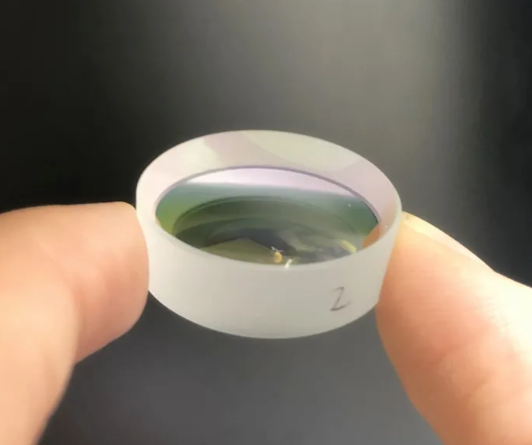
One of the most important properties of a plano concave lens is its negative focal length. This means that instead of converging light to a real focus, it causes the rays to diverge as if they originate from a virtual focal point. The degree of divergence depends on the curvature of the concave surface and the refractive index of the lens material.
Another key property is beam expansion. When a collimated beam of light passes through the lens, the beam diameter increases. This makes the lens extremely useful in applications where beam shaping or beam spreading is required.
The lens also produces a virtual, reduced image when used in imaging systems. Unlike magnifying lenses, it does not enlarge objects; instead, it decreases image size and adjusts optical paths. This characteristic is important in systems where compact optical design or controlled light distribution is required.
In addition, plano concave lenses are often used to reduce optical aberrations when combined with other lenses. By carefully selecting curvature and positioning, they help correct distortions such as spherical aberration, improving overall image quality in optical assemblies.
The performance of a plano concave lens is not determined only by its shape but also by the material used. Different optical materials are chosen depending on the required wavelength range and application environment.
Common materials include optical glass for general visible-light applications, fused silica for high-power laser systems, and infrared-transmitting materials for thermal imaging and IR optics. Each material offers different advantages in terms of transmission range, durability, thermal stability, and resistance to laser damage.
Surface quality is another critical factor. High-precision optical systems require lenses with very smooth surfaces to minimize scattering and energy loss. Even small imperfections can affect beam quality, especially in high-power laser applications.
Dimensional accuracy is also important. Parameters such as thickness, curvature radius, and centration must be tightly controlled to ensure predictable optical performance. In precision systems, even minor deviations can affect beam alignment and overall system efficiency.
To improve performance, many plano concave lenses are coated with anti-reflective layers. These coatings reduce surface reflections, increase transmission efficiency, and enhance durability in demanding environments. Depending on the application, coatings may be optimized for ultraviolet, visible, or infrared wavelengths.
The main function of a plano concave lens is to control the direction and distribution of light. When light passes through the lens, it is refracted in a way that causes the rays to spread outward. This makes the lens especially useful for adjusting beam size and divergence angle.
In optical design, this property is often used to manipulate laser beams. For example, a narrow, high-intensity laser beam can be expanded into a wider beam to reduce intensity or to match the requirements of a specific optical system. This is essential in applications where beam uniformity and control are required.
The lens can also be used to modify the effective focal length of optical systems. When placed in combination with other lenses, it helps engineers fine-tune how light converges or diverges within the system. This level of control is important in achieving precise optical alignment.
Plano concave lenses are widely used in laser technology. One of their most common roles is beam expansion. In laser systems, beams often need to be adjusted in size before reaching a target or passing through other optical components. The lens ensures that the beam spreads evenly without introducing significant distortion.
They are also used in beam shaping systems. In many industrial and scientific applications, laser beams must be modified to achieve specific intensity distributions. The diverging nature of the lens helps achieve controlled spreading of light.
In imaging systems, plano concave lenses are often used in combination with other lenses to improve performance. They help correct optical aberrations and enhance image clarity. This is important in devices such as microscopes, telescopes, and projection systems, where precision imaging is required.
Another important application is in optical instrumentation. In laboratory equipment, these lenses are used to control light paths, adjust magnification levels, and optimize system performance. Their ability to manipulate light without introducing strong focusing effects makes them ideal for calibration and measurement systems.
They are also commonly found in medical and scientific devices that rely on precise light control. In diagnostic and analytical instruments, they help guide and shape light beams to ensure accurate readings and stable operation.
One of the main advantages of a plano concave lens is its simplicity. Despite its simple design, it provides highly predictable optical behavior, making it easy to integrate into complex systems.
Another advantage is its versatility. By selecting different materials, coatings, and curvature values, the lens can be adapted to a wide range of wavelengths and applications, from ultraviolet to infrared systems.
It also offers high reliability in laser environments. When properly manufactured and coated, it can withstand high optical power levels while maintaining stable performance over time.
In addition, its ability to work in combination with other optical components makes it highly valuable in system design. It is rarely used alone but instead serves as an important building block in more complex optical assemblies.
A plano concave lens is a simple yet essential optical component that plays a major role in controlling and shaping light. Its negative focal length allows it to diverge light rays, making it ideal for beam expansion, optical correction, and system optimization.
Through careful selection of material, coating, and geometric parameters, it can be tailored for a wide range of applications, from industrial laser systems to precision imaging instruments. Its versatility, stability, and predictable optical behavior ensure that it remains a key element in modern optical engineering.
Hot Products


