Sep. 15, 2026
Share:
When an optical system must reproduce an object at 1:1 magnification, even a small imbalance between the object distance, image distance, lens curvature, or lens alignment can produce noticeable dimensional error, coma, defocus, and edge distortion. This is not merely a laboratory inconvenience: in machine vision, metrology, semiconductor inspection, and document imaging, an incorrect lens choice can cause rejected parts, unreliable measurements, redesign costs, and delayed production launches. In my experience, the central reason engineers consider a bi-convex lens for this task is its geometric symmetry. When the object and image are located at approximately equal distances, a properly oriented bi-convex or double-convex Spherical Lens can distribute optical power more evenly across its two surfaces.
For teams evaluating an optical spherical lens manufacturer, Sunday Optics provides a practical starting point for understanding how lens geometry, material, tolerance, and application conditions influence 1:1 imaging performance.
A 1:1 imaging system has a lateral magnification of:
[ m=\frac{h_i}{h_o}=-1 ]
The negative sign indicates that the image is inverted, while the absolute value of 1 indicates that the image and object have the same size.
For a thin positive lens, the governing equations are:
[ \frac{1}{f}=\frac{1}{s_o}+\frac{1}{s_i} ]
and
[ m=-\frac{s_i}{s_o} ]
When the magnification is exactly 1:1:
[ s_o=s_i ]
Therefore:
[ s_o=s_i=2f ]
For example, with a nominal focal length of 50 mm, the ideal thin-lens arrangement places the object and image approximately 100 mm from the principal plane. Real lenses require adjustment because center thickness, refractive index, lens mount position, and principal-plane displacement affect the final working distance.
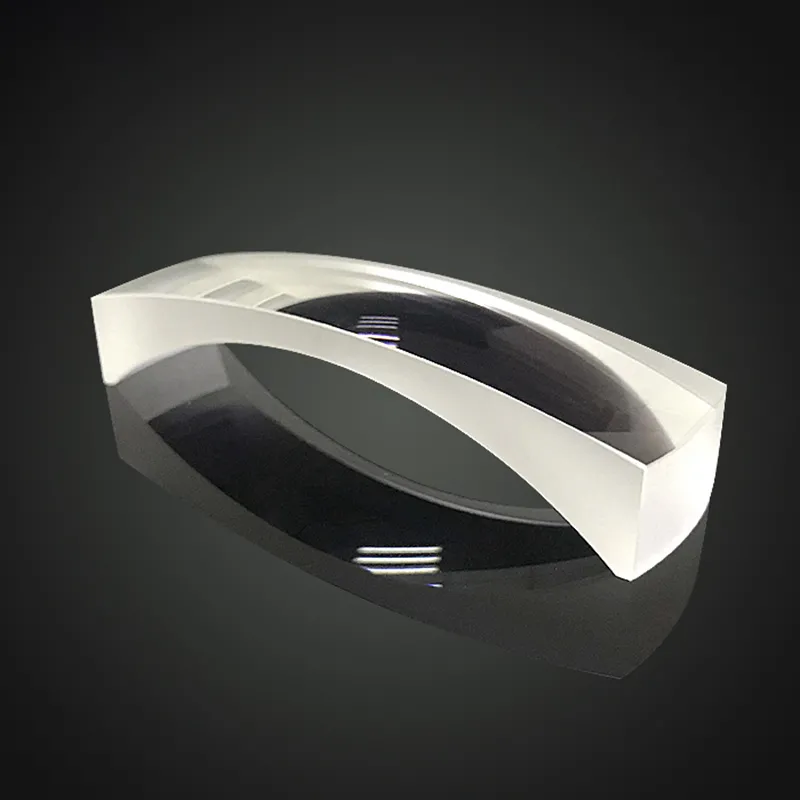
A bi-convex lens has two outward-facing convex surfaces. If the two surfaces have similar radii, the lens is approximately symmetric from front to back. This symmetry is particularly useful when:
A plano-convex lens can also form an image, but its asymmetric shape generally performs best when used with a specific orientation and an unequal object-to-image distance. At 1:1 conjugates, a symmetric bi-convex design usually provides a better balance of aberrations.
The most important reason is that the bi-convex profile is naturally compatible with equal object and image distances. At 1:1 magnification, light travels through the optical system in a nearly reciprocal arrangement. A symmetrical lens distributes refraction between its first and second surfaces instead of placing most of the optical power on one side.
This helps reduce the imbalance that may occur when an asymmetric lens is used outside its preferred conjugate ratio.
A symmetrical bi-convex Spherical Lens is therefore often selected for:
Spherical aberration occurs because marginal rays and paraxial rays do not converge at exactly the same point. The problem becomes more visible when the lens is used at a larger numerical aperture.
A bi-convex lens does not eliminate spherical aberration. However, at approximately equal conjugates, a carefully designed symmetric lens can distribute the aberration more evenly than a plano-convex lens used in the wrong orientation or at an unsuitable conjugate ratio.
This distinction is important: the correct lens is not determined by shape alone. Surface radius, glass type, diameter, center thickness, clear aperture, and coating also affect image quality.
For many 1:1 imaging applications, a bi-convex lens is more economical than a multi-element objective or telecentric lens. It can offer acceptable performance when the system has:
For high-precision metrology, a single bi-convex lens may not be sufficient. A telecentric objective, achromatic doublet, or multi-element imaging assembly may be required to control distortion, chromatic aberration, and chief-ray angle.
The suitability of a bi-convex lens comes from several interacting optical principles rather than one isolated feature.
At equal conjugates, reversing the direction of propagation produces nearly the same geometrical relationship. A symmetric lens takes advantage of this reciprocity. The result is a more balanced optical path for object-side and image-side rays.
The optical power of a lens depends on surface curvature and refractive index. A simplified lensmaker’s equation is:
[ \frac{1}{f}=(n-1)\left(\frac{1}{R_1}-\frac{1}{R_2}\right) ]
where:
In a bi-convex lens, the curvature is shared by two refracting surfaces. This can be advantageous at unity magnification because the lens does not rely on one strongly powered surface and one flat surface.
Coma causes point objects away from the optical axis to appear comet-shaped. A symmetric lens configuration can reduce certain coma contributions around equal conjugates, although off-axis performance still depends on aperture and field angle.
For a wide field or demanding image sensor, I would not approve a bi-convex Spherical Lens solely from its nominal focal length. I would also request ray-trace data, distortion data, and a specified image circle.
A basic bi-convex lens made from a single optical glass does not correct chromatic aberration. Different wavelengths focus at different axial positions because the refractive index changes with wavelength.
If the system uses white light, color cameras, or precision edge detection, consider:
| Lens type | Suitability near 1:1 | Main advantage | Main limitation |
|---|---|---|---|
| Symmetric bi-convex lens | Good for moderate performance | Balanced geometry and low cost | Residual spherical and chromatic aberration |
| Plano-convex lens | Possible with careful orientation | Simple and widely available | More sensitive to orientation and conjugate ratio |
| Achromatic doublet | Very good | Improved color correction | Higher cost and larger assembly |
| Telecentric lens | Excellent for metrology | Low magnification variation and controlled chief rays | Higher price and more complex integration |
| Aspheric lens | Good in compact systems | Strong aberration control | More demanding manufacturing and testing |
The table shows why the answer to “Why Are Bi-Convex Lenses Suitable for 1:1 Imaging?” is qualified rather than absolute. They are suitable when the accuracy, field, wavelength, and aperture requirements match their optical limitations.
Suppose we need to image a 10 mm object at 1:1 magnification using a 50 mm focal-length bi-convex lens.
The first-order arrangement is:
In practice, we would then optimize:
Lens orientation
For equal conjugates, a symmetric bi-convex lens is generally less orientation-sensitive than a plano-convex lens.
Clear aperture
A smaller working aperture can reduce marginal-ray aberrations, though it also reduces light throughput.
Focus adjustment
The nominal 2f location is only a starting point. Mechanical adjustment is required to compensate for principal-plane position and assembly tolerances.
Object illumination
Uneven illumination can look like optical nonuniformity. Coaxial, diffuse, or telecentric lighting may be necessary.
Sensor sampling
If a 5 µm feature must be resolved, the lens, sensor pixel pitch, MTF, vibration, and focus stability must all support that target.
Choosing a qualified optical spherical lens manufacturer is as important as selecting the lens type. A nominal “50 mm bi-convex lens” can vary significantly in performance depending on the manufacturing specification.
When we evaluate a supplier such as Sunday Optics, I recommend requesting a controlled technical drawing that identifies:
Quality documentation should reference recognized practices such as ISO 10110 or DIN ISO 10110 for optical drawing and surface documentation. Surface quality may also be specified using the applicable MIL or ISO-based inspection method agreed in the purchase specification. ASTM procedures can be relevant for material, coating, or environmental testing, but the exact standard must match the test being performed.
A responsible supplier should also define whether dimensional inspection is performed with calibrated equipment and whether critical dimensions are measured with an accuracy such as 0.01 mm. “100% inspection” should only be claimed when every required unit and characteristic is actually inspected and recorded.
The lens decision affects more than image sharpness. It influences the total cost of ownership and the commercial reliability of the finished product.
If a company uses an unsuitable lens for 1:1 imaging, it may experience:
A low-cost lens can become expensive if it forces a redesign of the camera housing or lighting system.
Assume an inspection line processes 20,000 components per day. If an optical setup creates only a 1% false-rejection rate, approximately 200 parts may require reinspection daily. If each review costs US$2 in labor and handling, the direct review cost reaches about US$400 per day, excluding production interruptions and customer risk.
The actual value will differ by industry, but the example demonstrates why optical stability matters. Spending more time on conjugate selection and lens validation can be less expensive than correcting an unstable production system.
Ignoring the optical requirements behind 1:1 imaging can create problems that become more severe as the business changes.
A manual setup may appear acceptable during prototyping. At higher throughput, small focus and distortion errors can multiply into significant scrap or reinspection costs.
A lens that works for ±0.5 mm inspection may fail when the requirement changes to ±0.05 mm. The original single-element design may lack the MTF, centering accuracy, or distortion control needed for the new target.
Changing from monochromatic illumination to broadband light can expose chromatic focus errors. Changing from diffuse lighting to reflective illumination can also reveal surface and alignment problems.
If the replacement supplier uses a different glass type, radius tolerance, coating, or inspection method, the new lens may not be optically interchangeable even when the catalog dimensions appear identical.
For that reason, I recommend retaining a complete optical specification rather than purchasing by diameter and focal length alone.
Before ordering a bi-convex Spherical Lens for 1:1 imaging, confirm:
Ask for a prototype or sample evaluation when the application involves metrology, high-speed inspection, or a large production volume. A supplier’s engineering team should be able to discuss focal-length tolerance, principal-plane location, edge quality, and mounting compatibility—not only provide a catalog drawing.
So, Why Are Bi-Convex Lenses Suitable for 1:1 Imaging? Their approximately symmetric geometry matches equal object and image distances, helping distribute optical power and balance aberrations at unity magnification. This makes them a practical and cost-effective choice for many moderate-performance imaging systems.
However, a bi-convex lens is not automatically the best solution for every application. Resolution, chromatic aberration, distortion, aperture, mechanical tolerance, and inspection standards must be considered together. By working with an experienced optical spherical lens manufacturer such as Sunday Optics, specifying measurable tolerances, and validating the complete optical system before mass production, we can reduce calibration risk and protect long-term business performance.
Hot Products


