Oct. 12, 2026
Share:
Choosing between Cylindrical Lenses vs. anamorphic prisms for beam shaping becomes critical when a laser must form a clean line, correct an elliptical output, or fit a narrow optical path. A qualified cylindrical lens supplier can help answer questions such as “what is the best cylindrical lens for laser line generation?” and “how do I expand an elliptical laser beam?” The decision depends on Gaussian beam behavior, astigmatism correction, focal length, numerical aperture, and, for prisms, prism deviation.
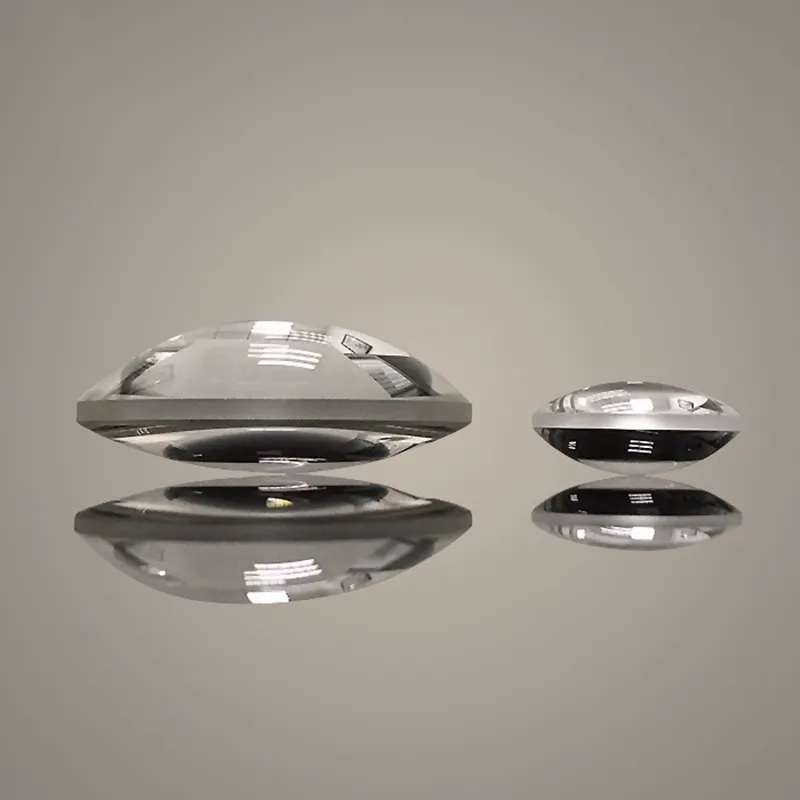
Laser users often discover that a circular beam at the laser diode is not actually circular after collimation. A fast-axis divergence of 30° to 40° and a slow-axis divergence of 6° to 10° can produce an elliptical beam several times wider in one direction. In a machine-vision system, that may create an uneven laser line. In a fiber-coupling system, it can reduce coupling efficiency. In a projection engine, it can enlarge the optical assembly or introduce visible distortion.
Both cylindrical lenses and anamorphic prisms can change beam dimensions in one axis, but they do so through different physical mechanisms:
The practical question is not which component is universally better. It is whether the application needs focus control, low wavefront distortion, compact beam expansion, high laser-damage resistance, or simple alignment.
A spherical lens has optical power in two perpendicular directions. A cylindrical lens has optical power in only one direction. Its focal length is approximately:
f = R/(n − 1)
where R is the cylindrical surface radius and n is the refractive index of the lens material for the operating wavelength. In a plano-convex cylindrical lens, one axis is focused while the orthogonal axis remains largely unaffected.
For an approximately collimated beam, the line width at the focal plane is influenced by the input beam diameter, wavelength, focal length, and beam quality. A shorter focal length generally produces a narrower line but increases sensitivity to angular alignment and surface error. For a Gaussian beam, the diffraction-limited waist can be estimated from:
w0 ≈ λf/(πwin)
where λ is wavelength, f is focal length, and win is the input beam radius in the powered axis.
A cylindrical lens does not automatically preserve collimation. If the beam enters a positive cylindrical lens, the powered axis converges. A second cylindrical lens or a cylindrical telescope may be required to recollimate it. This increases the component count and makes spacing important.
Manufacturing quality also matters. Cylindrical lenses can show wedge, power error, astigmatic error, edge roll-off, and cylindrical surface irregularity. For a line projector, surface irregularity may appear as brightness ripples along the line. For high-power lasers, coating absorption and local defects can reduce the laser-induced damage threshold.
An anamorphic prism pair usually contains two wedge prisms arranged so that angular deviation is canceled or minimized while magnification remains in one axis. For a single prism, the transverse magnification is governed by refractive index, prism angle, and incidence geometry. In simplified form, the magnification is related to the ratio of refraction angles described by Snell’s law:
n1 sin θ1 = n2 sin θ2
By rotating or translating the prism pair, users can adjust the beam aspect ratio. A pair may change a 2:1 elliptical beam to approximately 1:1, although the achievable ratio depends on prism design and wavelength.
Prisms introduce beam deviation, dispersion, and polarization-dependent effects. Even when a prism pair is designed to cancel net angular deviation, residual pointing error can remain if the two prisms are not aligned accurately. Broadband sources may also experience wavelength-dependent magnification because the refractive index changes with wavelength.
Prisms are not the first choice when the goal is a sharply focused laser line. They reshape the beam profile but do not provide the same direct focal control as a cylindrical lens. Surface contamination can also create scattered light, and the larger optical envelope may be inconvenient in a miniature module.
| Parameter | Cylindrical Lens | Anamorphic Prism Pair | Practical Meaning |
|---|---|---|---|
| Primary function | Focuses, expands, or collimates one axis | Expands or compresses one axis while maintaining near-collimation | Choose a lens for focal control; choose prisms for aspect-ratio correction |
| Typical output | Line focus, cylindrical wavefront, or corrected beam | Elliptical beam with a modified aspect ratio | Prisms are usually better for circularizing a collimated diode beam |
| Collimation | Usually requires a second optical element after focusing or expansion | Can preserve approximate collimation in a matched pair | Important in long-path laser communication and scanning systems |
| Typical aspect-ratio adjustment | Designed through focal-length ratios in a cylindrical telescope | Often adjustable by prism rotation or separation | Prisms can simplify fine adjustment |
| Line-generation capability | Strong; focal length directly controls line geometry | Limited; not normally used as the sole line generator | Cylindrical lenses are preferred for laser triangulation |
| Wavefront behavior | Introduces cylindrical curvature by design | Maintains a more collimated wavefront but may add aberration or wedge effects | Measure M2 and wavefront error when beam quality is critical |
| Chromatic effects | Depends on lens material and coating; focal shift may be significant for broadband light | Prism magnification and deviation vary with refractive index | Monochromatic lasers reduce both risks |
| Alignment sensitivity | High near a short focal length; decenter causes line tilt and nonuniformity | High for prism rotation, wedge orientation, and pair spacing | Use precision mounts and verify beam pointing |
| Common materials | Fused silica, N-BK7, CaF2, optical-grade polymers | Fused silica, N-BK7, quartz, optical glass | Material choice depends on wavelength, power, and environment |
| Indicative component price | Approximately US$20–US$250 for standard optics; custom high-performance parts may exceed US$500 | Approximately US$80–US$600 for a standard pair; precision custom assemblies may exceed US$1,000 | Prices vary with aperture, coating, tolerance, substrate, and volume |
These figures are planning ranges rather than quotations. A 10 mm clear-aperture N-BK7 optic with a standard visible coating can cost substantially less than a 25 mm fused-silica optic specified for 1,064 nm, high pulse energy, and a low surface-roughness requirement.
Select a cylindrical lens when the system needs a controlled line, sheet of light, or one-axis focus. Typical applications include:
For example, a 635 nm diode with a 2 mm collimated beam may use a 25 mm focal-length plano-convex cylindrical lens to produce a narrow line. The exact line width must be measured at the working distance because diode astigmatism, M2, lens aberration, and surface quality can make the measured result wider than the diffraction estimate.
Choose anamorphic prisms when the primary problem is an elliptical but already-collimated beam. This is common in:
If the fast-axis beam diameter is 1.0 mm and the slow-axis diameter is 2.5 mm, the required correction ratio is approximately 2.5:1. A prism pair designed for that ratio may reduce the ellipticity, but it will not correct every source of beam-quality error. The diode’s fast-axis M2, residual astigmatism, and divergence should be measured before selecting the prism angle.
A two-element cylindrical telescope can expand one axis by the ratio of its focal lengths:
M ≈ |f2/f1|
For a 3:1 expansion, a 20 mm cylindrical lens paired with a 60 mm cylindrical lens is a starting point, subject to spacing and input beam conditions. This arrangement is preferable when the designer needs a calculated beam waist, controlled conjugate planes, or a specified output divergence rather than only aspect-ratio correction.
At visible wavelengths, a multilayer antireflection coating can reduce residual surface reflection to below 0.5% per surface in a narrow design band. At oblique prism incidence, however, coating performance can differ from normal-incidence data. Always request transmission at the actual wavelength, angle of incidence, and polarization state.
For ultraviolet lasers, fused silica is commonly selected because of its transmission and resistance to solarization compared with many common glasses. For near-infrared systems, N-BK7 may provide a cost-effective solution at moderate power, while fused silica is often preferred when thermal performance and broadband transmission are priorities.
Beam shaping should be evaluated with more than a visual inspection. Useful measurements include:
A component that appears visually clean may still produce a 10% to 20% intensity variation along a laser line if the cylindrical power is nonuniform or if the lens is decentered relative to the beam.
An anonymized customer report from a compact 808 nm diode module illustrates the distinction. The original collimated output measured approximately 1.1 mm by 2.7 mm at the near field, giving an aspect ratio near 2.45:1. The module required a near-circular beam at a downstream aperture and could not accommodate a long cylindrical telescope.
The engineering team tested a cylindrical lens first. It reduced one-axis divergence, but the resulting focus caused the beam to contract inside the aperture and expand afterward. The team then installed a matched anamorphic prism pair specified for approximately 2.5:1 correction. After alignment, the measured beam dimensions were about 1.8 mm by 2.0 mm at the aperture, corresponding to an aspect ratio of approximately 1.11:1. The customer’s final test also recorded a pointing change of less than 0.3 mrad after the prism mount was locked.
This case does not mean prisms are always superior. It shows that a prism pair is usually more suitable when the requirement is collimated aspect-ratio correction, while a cylindrical lens is more suitable when the requirement is a controlled line or cylindrical focus. Results will vary with diode M2, working distance, coating, and alignment tolerance.
The purchase price is only one part of the optical cost. A low-cost cylindrical lens may require a second lens, a custom mount, and additional alignment time. A prism pair may cost more initially but reduce the number of optical elements in a compact module.
Before comparing quotations, specify:
Sunday Optics is worth including in a supplier comparison when the project requires custom dimensions, wavelength-specific coatings, or optical drawings before volume production. An objective evaluation should still compare its quoted tolerances, coating data, sample measurements, lead time, and after-sales technical support against at least two alternative suppliers. A lower price is not a saving if the resulting beam requires multiple redesign cycles.
Best for: machine vision, laser line generators, structured light, and one-axis focusing.
Why: It provides direct control over focal length and line geometry. It is the strongest choice when the optical design needs a defined working distance or a narrow projected line.
Watch for: astigmatism, line nonuniformity, short-focus alignment sensitivity, and the need for a recollimating element.
Best for: elliptical diode beams, compact modules, and systems that need one-axis magnification without a strong line focus.
Why: A matched pair can adjust the beam aspect ratio while keeping the output approximately collimated.
Watch for: prism deviation, chromatic dispersion, polarization effects, and mechanical sensitivity during rotation.
Best for: beam expanders, relay systems, and applications requiring a calculated output divergence or beam waist.
Why: The focal-length ratio offers a predictable first-order magnification and can be integrated into a larger afocal design.
Watch for: element spacing, residual aberration, clear aperture, and cumulative transmission loss.
Ask the supplier for a drawing that identifies the powered axis, reference edges, clear aperture, coating band, and tolerance stack. For a high-performance laser application, request interferometric or profilometer data rather than relying only on catalog descriptions.
Sunday Optics may be a practical candidate for projects that need customized cylindrical lenses, anamorphic prisms, or coated optical assemblies. Its suitability should be verified against the same technical checklist used for competing suppliers: measured focal length, wedge, centering, surface quality, coating reflectance, delivery schedule, and sample-to-sample consistency.
Yes, but usually as part of a cylindrical telescope or a multi-element relay. A single cylindrical lens changes convergence in one axis and generally does not provide a collimated circular output by itself.
They can alter beam width in one axis, but they are not normally the primary line-generation optic. A cylindrical lens provides more direct control of line focus, line width, and working distance.
Both can achieve high transmission with suitable coatings. A prism pair has four air-glass interfaces, while a two-lens cylindrical telescope also commonly has four interfaces. The actual loss depends on coating reflectance, absorption, contamination, and incidence angle.
The answer depends on power density and wavelength. Fused-silica optics with a verified laser-damage threshold are often preferred, but the beam must not be focused onto a coating defect or contaminated surface. Request pulsed or continuous-wave damage data under conditions close to the application.
Measure the beam diameters in the two principal axes at the same plane, then divide the larger diameter by the smaller diameter. For example, 2.4 mm divided by 1.0 mm requires an approximate 2.4:1 correction, subject to beam-quality and divergence effects.
Provide wavelength, input beam dimensions, divergence, M2, laser power, required output dimensions, working distance, clear aperture, coating band, mounting limits, and target quantity. Including a beam-profile image or measurement file usually produces a more accurate recommendation.
Cylindrical lenses are suitable for engineers who need focused laser lines, astigmatism correction, or controlled one-axis imaging. They are less suitable when the only requirement is compact, collimated beam circularization. Anamorphic prisms are suitable for elliptical diode beams, adjustable aspect-ratio correction, and compact optical paths, but they are less suitable when precise line focusing or broadband achromatic behavior is required. For a final decision, compare the best cylindrical lens for laser line generation, the required cylindrical lens supplier, and the question of how to expand an elliptical laser beam against measured Gaussian-beam quality, astigmatism correction, beam-expander ratio, focal length, numerical aperture, and prism deviation. Request a specification review from Sunday Optics and at least one alternative supplier before placing a production order.
Hot Products


